
External Validation of the AI-based Thermographic Indices for Rheumatoid Arthritis
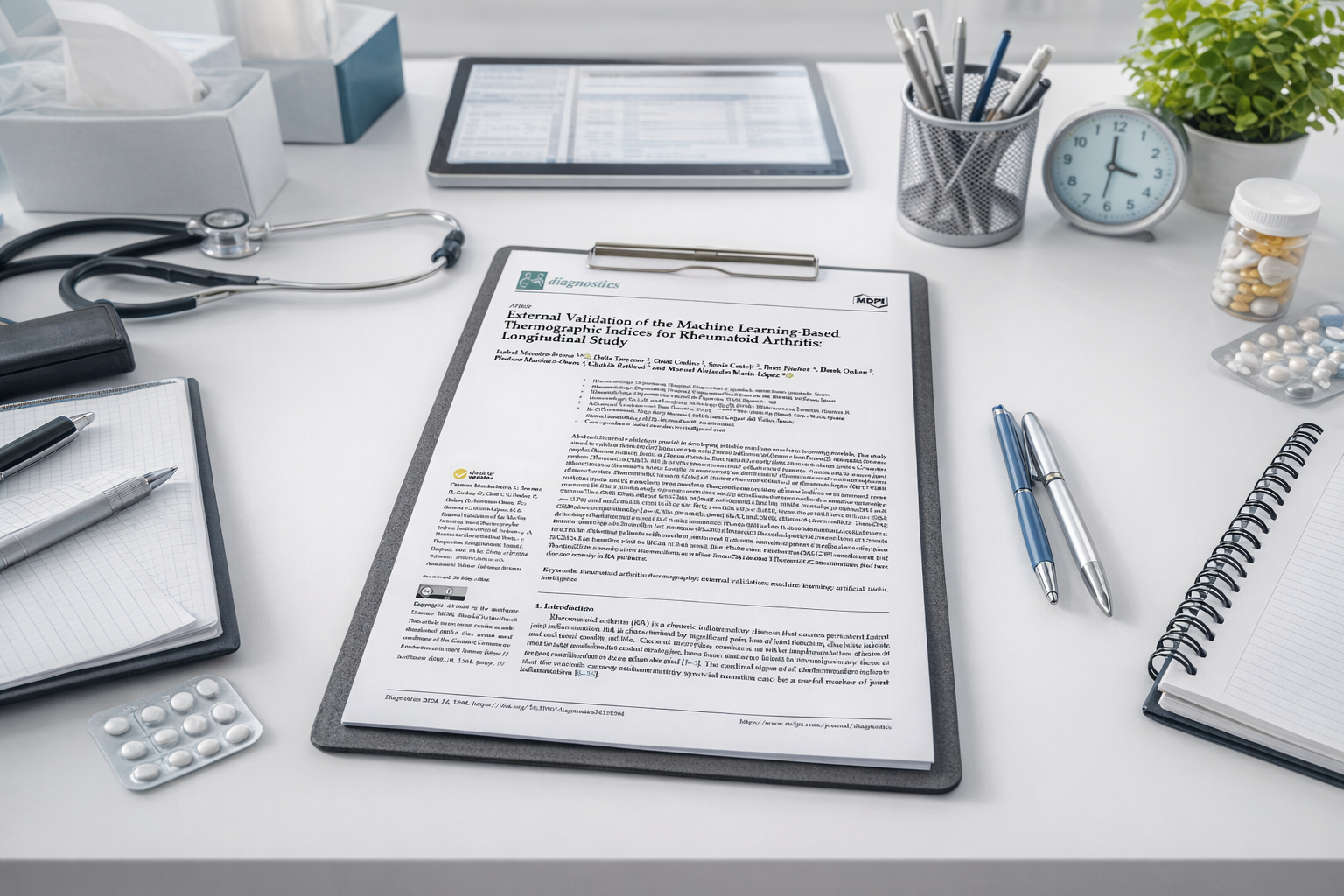
Ensuring that new medical technologies work reliably across different clinical settings is crucial for their adoption. While our initial studies showed promising results, external validation is the gold standard for proving robustness.
We are thrilled to announce the publication of our latest study in Diagnostics, which provides the first external validation of our AI-based thermographic indices in a prospective longitudinal cohort.
📄 The Study: Multicenter Validation
In this prospective observational study, we recruited 77 patients with Rheumatoid Arthritis (RA) from three different hospitals in Spain (Hospital Universitari d'Igualada, Hospital Universitari Sant Joan de Reus, and Hospital de Figueres).
The goal was to validate our previously developed indices—ThermoJIS (Thermographic Joint Inflammation Score), ThermoDAI, and ThermoDAI-CRP—in an independent population. We followed these patients for 12 weeks to assess not just the accuracy of the tools at a single point in time, but their ability to detect changes in disease activity and response to treatment.
This study was conducted in collaboration with our partner, the multinational pharmaceutical company Eli Lilly and Company, with the objective of evaluating the potential use of this tool in their rheumatoid arthritis clinical trials.
🔍 Key Findings
- Strong Clinical Correlation: Both ThermoDAI and ThermoDAI-CRP showed strong correlations with established disease activity scores (DAS28, CDAI, and SDAI), confirming that they accurately reflect the patient's clinical status.
- Sensitivity to Change: The study demonstrated that our indices can effectively detect improvement in patients undergoing treatment. ThermoDAI-CRP, in particular, showed high accuracy in identifying patients achieving ACR20 and ACR50 responses.
- Detecting Subclinical Inflammation: ThermoJIS continued to show its value by identifying inflammation in joints that appeared normal on physical examination, highlighting its potential to detect subclinical synovitis.
💡 Why does it matter?
This study confirms that our AI-driven thermography is not just a research concept but a potential clinical tool. By validating the technology in a multicenter setting, we have shown that it performs reliably across different environments and patient populations.
This is a major step towards implementing AI-assisted thermography for RA patients management. It supports the use of thermal imaging as a scalable solution to complement standard clinical assessments, potentially reducing the need for more expensive or time consuming imaging techniques, while enabling efficient remote monitoring.
"These results support the efficacy of ThermoJIS for assessing joint inflammation, as well as ThermoDAI and ThermoDAI-CRP for assessing disease activity in RA patients."
🚀 Next Steps: Toward International Validation
Having successfully validated the model developed in Spain across a national multicenter cohort, our goal now is to globalize the evidence.
The next step in our roadmap is international validation. We will expand our studies to larger and more diverse cohorts in other countries to ensure the total generalization of our algorithms. This will consolidate our technology as a new standard of support for rheumatologists worldwide.
👇 Read the full article here: https://www.mdpi.com/2075-4418/14/13/1394
Reference: Morales-Ivorra I, Narváez J, et al. External Validation of the Machine Learning-Based Thermographic Indices for Rheumatoid Arthritis: A Prospective Longitudinal Study. Diagnostics 2024;14:1394. doi: 10.3390/diagnostics14131394